
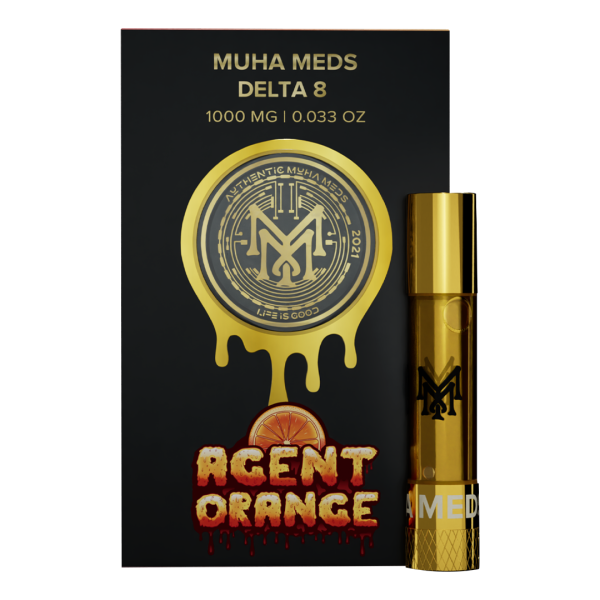
Muha Meds Agent Orange: The Good, the Bad & What to Know
Muha Meds Agent Orange is a 1G cartridge built around a bright citrus-forward profile. Current listings describe the flavor with orange, sweet citrus, earthy notes, and a subtle herbal character. The strain is commonly associated with Orange Velvet and Jack the Ripper, giving it a distinctive name and recognizable flavor identity.
For anyone researching this cartridge, the most useful details are its size, total content, flavor profile, cannabinoid formulation, hardware, and expected puff count.
Product Specifications
| Detail | Information |
|---|---|
| Brand | Muha Meds |
| Product | Agent Orange |
| Format | Pre-filled cartridge |
| Size | 1G |
| Total Content | Approximately 1000MG |
| Profile | Citrus-forward hybrid |
| Flavor | Orange, citrus, sweet, earthy |
| Cannabinoid | Formulation dependent |
| Puff Count | Varies by hardware and draw length |
| Hardware | Cartridge format |
Current product catalogs list the cartridge at 1 gram, while some listings describe the same size as 1000MG.
A Bright Citrus Flavor Profile
The standout feature is the orange-forward taste.
Rather than relying only on sweetness, the profile combines several layers:
- Orange: The dominant fruity character
- Citrus: Adds a sharper, zesty edge
- Sweet: Softens the sharper citrus notes
- Earthy: Gives the finish more depth
- Herbal: Adds a subtle botanical character
The overall combination creates a profile that sits between fresh citrus and traditional earthy cannabis flavors. Weedmaps currently describes the product using orange, citrus, earthy, and sweet flavor categories.
Orange and Citrus
The orange character gives the cartridge its recognizable identity. Citrus notes provide additional brightness, making the flavor more complex than a simple sweet profile.
Earthy Finish
Earthy notes provide contrast to the fruit-forward opening. This helps keep the flavor from becoming overly candy-like.
Herbal Character
Depending on the formulation, the finish can have a mild herbal quality that works alongside the citrus and earth notes.
1G / 1000MG Content
The listed cartridge size is 1G, which corresponds to approximately 1000MG of total cartridge contents by weight.
That number should not automatically be interpreted as 1000MG of THC or another specific cannabinoid. Total product weight and cannabinoid concentration are separate measurements.
Historical laboratory records demonstrate why the label and batch information matter. One 2023 PSI Labs report for an Agent Orange HHC cartridge recorded 89.861% total cannabinoids, with HHC listed at 89.861%.
A separate historical Delta-8 laboratory report for a 1G Agent Orange cartridge recorded 84.8225% Δ8-THC and 97.4374% total cannabinoids.
These are different formulations and laboratory samples. They should therefore be treated as historical batch information rather than a universal potency specification.
Puff Count
There is no dependable fixed number of puffs for every 1G cartridge.
Puff Count: Varies by hardware, draw length, airflow, battery temperature, and individual use.
Shorter draws generally consume less oil than long draws, while higher-temperature settings can affect consumption as well.
For that reason, an exact puff figure should only be published when it comes directly from the packaging or manufacturer documentation for the specific hardware.
What Is Agent Orange?
Agent Orange is a cannabis strain name associated with a citrus-heavy flavor profile. Current product information identifies Orange Velvet and Jack the Ripper as parent strains.
The name can sound aggressive, but the actual product profile is much more focused on fruit and citrus characteristics.
The flavor is generally described around:
Orange → Citrus → Sweet → Earthy
That combination makes the profile easy to distinguish from berry, grape, dessert, or tropical fruit varieties.
Cannabinoid Formulations Can Differ
One of the most important things to understand when researching this product is that the name alone does not establish a single cannabinoid formulation.
Historical records include:
- HHC formulation: A 2023 laboratory report recorded 89.861% HHC for a tested sample.
- Delta-8 formulation: Another 1G sample recorded 84.8225% Δ8-THC and 97.4374% total cannabinoids.
Because these reports concern different samples, formulations, and testing dates, consumers should check the current package rather than assuming an older COA applies to every product.
What to Check on the Package
Before relying on specifications found online, compare the physical package with available laboratory information.
1. Check the Size
Look for the stated 1G / 1000MG quantity.
2. Identify the Cannabinoid
Check whether the package identifies THC, HHC, Delta-8, Delta-10, or another cannabinoid.
3. Locate the Batch Number
A lot or batch number helps determine whether a laboratory report actually corresponds to the product being examined.
4. Review the COA
If laboratory documentation is provided, compare the batch number, product name, cannabinoid profile, and testing date.
5. Check the Hardware
Make sure the cartridge is compatible with the intended battery and review any instructions supplied with the product.
The Good and the Bad
The Good
The strongest feature is the distinctive flavor profile. Orange and citrus notes make the product easy to differentiate, while sweet and earthy elements add balance.
The 1G format also provides a clearly defined product size, and current listings consistently identify Agent Orange as a 1G cartridge.
Another positive is that historical laboratory documentation is available for multiple formulations, making it possible to research specific samples rather than relying entirely on generic descriptions.
The Bad
The main limitation is that specifications can vary between formulations and production periods.
Older laboratory reports should not automatically be used to describe a current cartridge. The historical HHC and Delta-8 reports demonstrate this variation clearly.
The puff count is another variable. Without confirmed hardware-specific testing, publishing an exact number could be misleading.
Agent Orange vs. Other Flavor Profiles
| Profile | Typical Character |
|---|---|
| Agent Orange | Orange, citrus, sweet, earthy |
| Berry | Fruity, sweet, berry-forward |
| Dessert | Creamy, sugary, vanilla-like |
| Tropical | Mango, pineapple, citrus |
| Diesel | Fuel, earthy, sharp |
| Mint | Cool, herbal, refreshing |
The citrus-forward character is what separates this option from many dessert and berry profiles.
Frequently Asked Questions
How much is in the cartridge?
The commonly listed format is 1G, or approximately 1000MG of total product.
How many puffs does a 1G cartridge provide?
There is no universal puff count. It depends on the cartridge hardware, draw length, airflow, battery settings, and individual usage.
What does it taste like?
The current listing describes orange, citrus, sweet, and earthy flavor characteristics.
Is Agent Orange a sativa or hybrid?
Classification can vary between product listings and formulations. The current Weedmaps listing identifies the cartridge as Hybrid, while other listings describe Agent Orange differently.
What cannabinoids are found in it?
Different historical samples have used different formulations. Laboratory records include HHC and Delta-8 versions, so the current package and batch-specific COA should be used to determine the actual cannabinoid composition.
Is 1000MG the same as 1000MG THC?
No. 1000MG refers to the approximate total product amount, not necessarily the amount of THC. Cannabinoid concentration must be determined from the product’s laboratory results or label.
Does the name guarantee the same flavor every time?
Not necessarily. Formulation, oil composition, terpene profile, and production batch can influence the final taste.
Final Overview
This citrus-forward cartridge stands out mainly because of its orange and sweet citrus character, balanced by earthy and herbal notes. Current listings identify the standard format as a 1G cartridge, equivalent to approximately 1000MG of total product.
The cannabinoid details require more attention because historical laboratory records show different versions, including HHC and Delta-8 formulations. Those older results are useful for understanding product history but should not be presented as the guaranteed specification of every current batch.
The puff count is also variable, so a manufacturer-confirmed number should be used whenever available.
Be the first to review “AGENT ORANGE”
Related products
Muha Meds Carts
Muha Meds Carts
Muha Meds Carts
Muha Meds Carts
Muha Meds Carts
Muha Meds Carts
Muha Meds Carts
Muha Meds Carts
Reviews
There are no reviews yet.